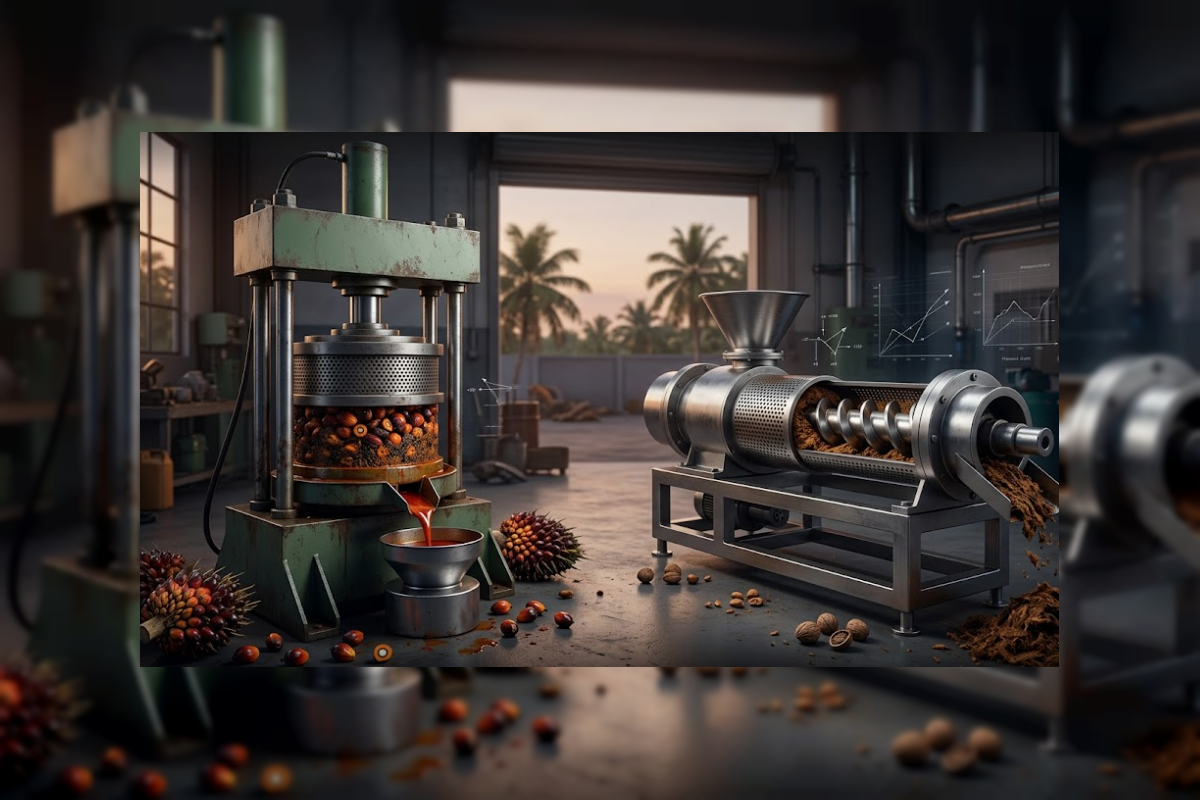

In the heart of Nigeria’s palm oil belt stretching from the groves of Akwa Ibom and Imo to the active milling hubs in Rivers and Edo states efficiency is the ultimate decider of profitability. For decades, small and medium-scale processors have relied on local mechanical fabrication to extract crude palm oil (CPO) from digested loose fruits.
However, a major engineering divide persists on the mill floor: The Vertical Hydraulic/Manual Press versus the Continuous Horizontal Screw Press.
Choosing the wrong extraction technology leads to catastrophic losses either through unextracted oil left behind in the fiber cake or high kernel breakage rates that ruin secondary income streams. In this technical deep dive, we break down the mechanical principles, pressure distributions, and structural performance of both systems to help you select or fabricate the ultimate machine for your milling setup.
1. The Mechanical Working Principle
To understand oil extraction, we must look at how fluid flows through compressed porous media. The objective is to apply enough force to breach the cell walls of the mesocarp (the fleshy outer layer of the fruit) and force the oil out through a perforated cage while retaining the solid fiber and nuts.
The Vertical Press (Discontinuous Batch Extraction)
The vertical press operates on a static, batch-processing mechanism. Digested palm fruit is loaded into a perforated cylindrical steel cage. A heavy metal plunger (press plate) is driven downward into the cage, either via a manual threaded screw or a vertical hydraulic jack.
Force Vector: Direct vertical compression
Material Flow: Completely static. The material does not move horizontally during compression; it is simply compacted until the maximum pressure limit of the hydraulic seal or mechanical screw is reached.
The Screw Press (Continuous Axial Extraction)
The screw press is a dynamic, continuous extraction machine. It consists of a rotating, tapered compression screw (worm shaft) housed inside a closely matching perforated horizontal barrel.
As the digested mash enters the hopper, the rotating screw forces the material forward. Because the pitch of the screw reduces or the shaft diameter increases towards the discharge end, the space inside the barrel shrinks. This progressive reduction in volume creates massive structural pressure.
Force Vector: Combined axial shearing force (F_axial) and radial compression (F_radial).
Material Flow: Dynamic and continuous. Material moves steadily from the feed hopper to the cake discharge outlet.
2. Pressure Distribution and Extraction Efficiency
The primary engineering metric for any oil press is its extraction efficiency; the percentage of total oil recovered from the mesocarp. This is completely dictated by how pressure is distributed inside the machine.
Vertical Press Constraints
In a vertical press, pressure is highest directly beneath the plunger and drops off significantly as you move down the cage.
Due to the frictional resistance of the palm fiber against the steel walls, the material at the bottom of the cage receives less compressive force. This results in an uneven extraction profile. Mill operators often have to unpack the cage, stir the semi-pressed cake, and press it a second time to achieve acceptable extraction rates.
Screw Press Advantages
The screw press relies on progressive compaction. The material is subjected to constant friction, turning, and shearing. This shearing action is mechanically superior because it tears open oil-bearing cells that simple static pressure might miss.
Furthermore, at the end of the barrel, an adjustable cone or counter-weight choke regulates the exit gap, maintaining a uniform, high-pressure zone throughout the entire continuous run.
3. Structural Comparison Matrix
| Engineering Metric | Vertical Palm Oil Press (Hydraulic/Manual) | Continuous Horizontal Screw Press |
| Operation Type | Batch (Load => Press => Unload) | Continuous (Constant input and output) |
| Throughput Capacity | Low to Medium (Typically 0.5 to 1.5 tons of FFB/day) | High (1.5 to over 10+ tons of FFB/day) |
| Oil Extraction Efficiency | 60% – 75% | 85% – 92% |
| Kernel Breakage Rate | Very Low (<2%). | Moderate to High ($5% - 12%) if poorly tuned |
| Power Requirement | Manual labor or small electric/diesel hydraulic pump | High-torque electric motor or 8HP–15HP diesel engine |
| Fabrication Cost | Low and highly accessible for local welding shops | High (Requires precision lathe turning and hard-facing) |
4. The Kernel Breakage Trade-Off
One of the most critical engineering challenges in palm oil processing is preserving the palm kernels during extraction. Broken kernels release kernel oil into the main mesocarp oil, degrading the quality of the CPO and reducing the market value of the nuts sold to palm kernel crushers.
Vertical Press Performance: Because the pressure is purely static and vertical, the nuts cushion each other. The structural forces rarely exceed the crushing strength of the shell. Kernel breakage is almost non-existent.
Screw Press Performance: The shearing action of the worm shaft drags the nuts against the hard perforated barrel walls. If the clearance between the screw flight and the barrel is incorrect, or if the discharge cone is set too tight, the machine acts as a grinder, leading to high kernel damage. Fabricators must precisely compute the screw pitch to match local fruit varieties (Dura vs. Tenera).
5. Maintenance and Local Fabrication Realities
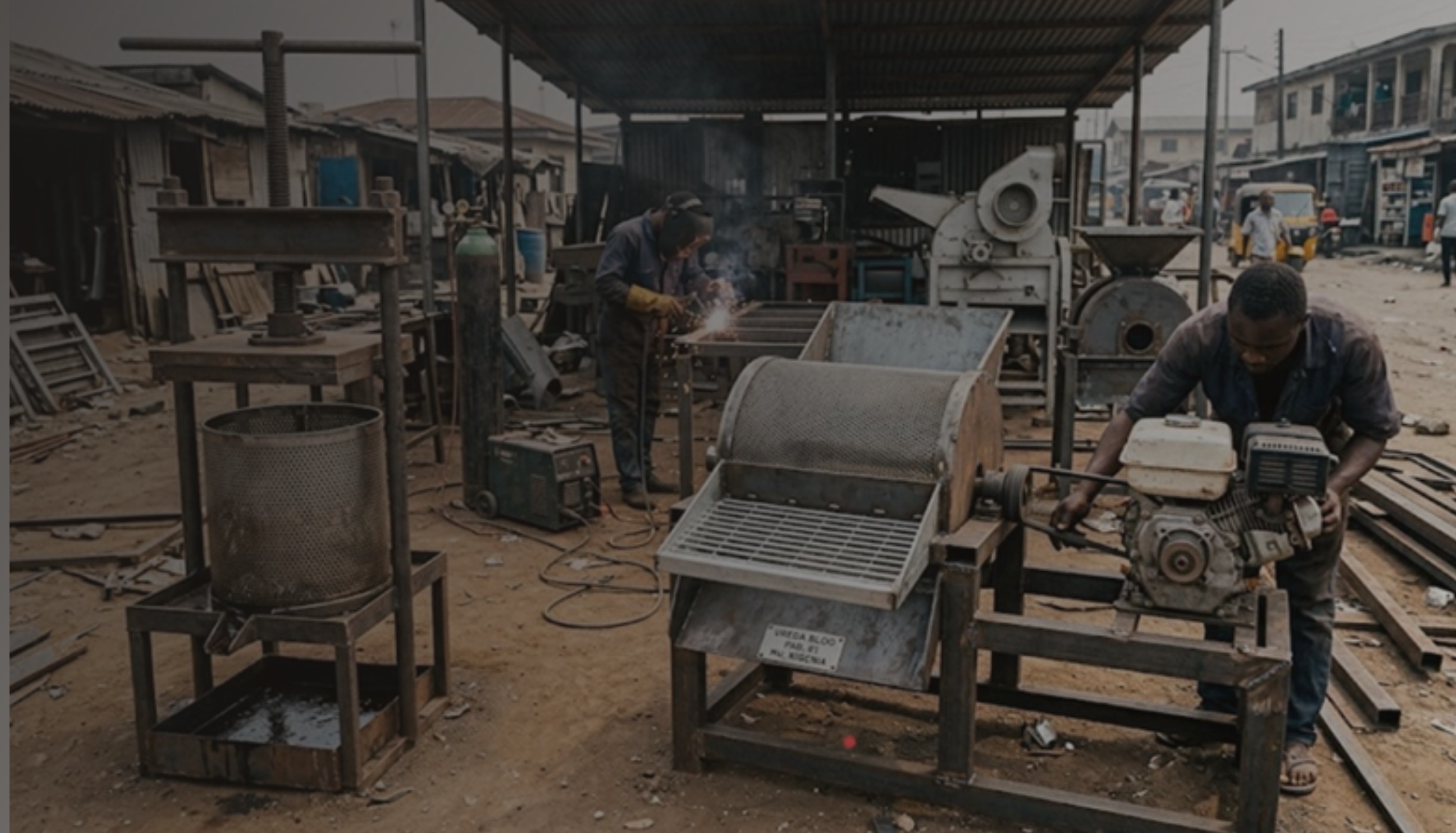
For a fabrication workshop in Nigeria, manufacturing these two machines requires entirely different tiers of engineering precision.
Fabricating the Vertical Press
This is highly accessible. The main components are structural mild steel channels, a heavy-duty seamless pipe for the cage, and a standard hydraulic jack (often repurposed from automotive machinery). The main point of failure is the hydraulic seals leaking under pressure or the welded base cracking due to poor weld penetration.
Fabricating the Screw Press
This requires advanced machinery. The worm shaft must be turned on a heavy-duty lathe with precise tapering. Because palm fiber is incredibly abrasive, the flights of the screw wear out rapidly. Local fabricators must use hard-facing welding electrodes (such as chromium carbide alloys) to overlay the screw edges, extending the component lifespan from a few weeks to several months of continuous operation.
Engineering Verdict: Which Should You Deploy?
The choice between a vertical press and a screw press comes down to processing volume and investment capital:
Go with the Vertical Press if: You are setting up a small-scale village mill, processing under 1 ton of Fresh Fruit Bunches (FFB) per day, operating on a tight budget, and want to maximize income from whole, unbroken palm kernels.
Go with the Screw Press if: You are scaling up to a commercial medium-scale mill, handling continuous daily tonnages, and require maximum oil yield per ton to outcompete local processors.
By understanding these mechanical principles, local fabricators can design robust equipment that minimizes downtime, while mill investors can make informed decisions that protect their margins from day one.
Comments (0)
No comments yet. Be the first!
Please login to leave a comment
Login to Comment